
The four games you will meet first
Slots, blackjack, roulette and baccarat fill most of a British casino lobby. Each has rules you can learn in a couple of minutes and details that take longer.
Slots
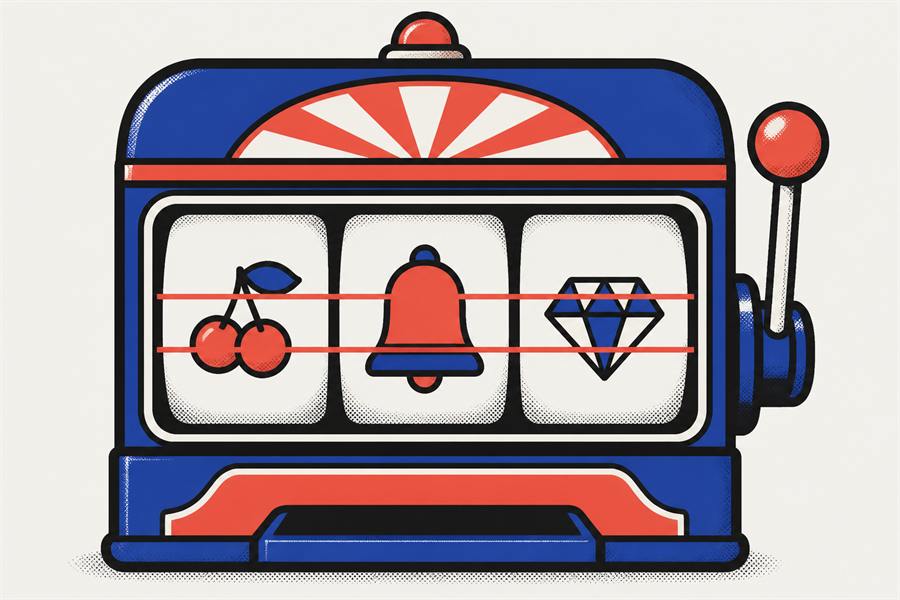
Symbols land on a set of reels, and a combination that matches the paytable returns something. That is the whole game. The variations are in the shape of it: three reels or five or six, twenty fixed paylines or 243 ways to win, cascading grids where winning symbols vanish and new ones drop in.
Three words carry most of the meaning. A wild substitutes for other symbols to complete a line. A scatter pays or triggers a feature regardless of where it lands. Volatility describes how the returns are distributed — a low-volatility game pays small amounts often, a high-volatility one pays rarely and larger, and two slots with the same published return can feel like different hobbies.
Anything sold as a slot strategy is decoration. Each spin draws from a generator that has no memory of the last one, so stake patterns, changing games at the right moment and waiting for a machine to be "due" all do precisely nothing. What you can control is the stake, the session length and the volatility you pick.
British rules changed the feel of online slots in October 2021. Autoplay is gone, a spin cannot resolve faster than 2.5 seconds, several slots cannot be played at once, and a game is no longer allowed to celebrate a return smaller than the stake with the sound and animation of a win.
Blackjack
Beat the dealer's hand without going past 21. Number cards count their face value, court cards count ten, and an ace counts one or eleven, whichever helps. Two cards totalling 21 is a blackjack and usually pays three to two, though some tables quietly pay six to five — worth checking before you sit down, because it is the single biggest rule difference on the felt.
On your turn you can hit for another card, stand, double your stake for exactly one more card, or split a pair into two hands. The dealer has no choices at all: house rules force them to draw to sixteen and stand on seventeen, which is why blackjack is the one table game where your decisions genuinely change the maths. Played with a basic strategy chart on favourable rules, the house edge sits near half a per cent.
Insurance is the exception worth naming. Offered when the dealer shows an ace, it is a side bet on the dealer having a ten underneath, and at the usual price it loses money over time. Decline it and the game stays simple.
Roulette
A ball is spun against a wheel of numbered pockets and settles in one of them. Bets are placed on a single number, a group of numbers, or one of the even-money propositions — red or black, odd or even, high or low. A straight-up number pays 35 to 1, which is generous until you notice how many pockets there are.
Which wheel you are on matters more than any betting pattern. European roulette has 37 pockets, one of them a single zero, and a house edge of 2.70% on every bet. American roulette adds a double zero, making 38 pockets and an edge of 5.26% — nearly twice as expensive for an identical-looking game. French roulette uses the single-zero wheel and adds la partage, returning half of an even-money stake when the ball lands in zero, which cuts the edge on those bets to 1.35%.
Systems such as the Martingale rearrange when you lose rather than whether you do. Doubling after a loss produces a long run of small wins and one very large loss, and the table maximum exists precisely to make sure that loss arrives.
Baccarat
The version in British lobbies is punto banco, and it involves no decisions at all. Two hands are dealt, called Player and Banker, and you bet on which will finish closer to nine. Tens and court cards count zero, aces count one, and totals drop the tens digit — a seven and a six make thirteen, which is three. Whether a third card is drawn is settled by a fixed table of rules that neither you nor the dealer can override.
Banker wins slightly more often than Player because of those drawing rules, which is why a winning Banker bet pays even money less a five per cent commission. After that commission the Banker bet carries a house edge of about 1.06%, and Player about 1.24%. The Tie bet pays eight to one and costs around 14% in expectation, which is a great deal more than it looks.
Its appeal is the pace and the absence of homework. There is no strategy to learn, no chart to memorise, and the scorecards offered at the table record history that has no bearing on the next hand.
The odds side by side
| Game | The main bet | Typical house edge | Do your decisions matter? |
|---|---|---|---|
| Blackjack | The hand itself, played with basic strategy | Around 0.5% on favourable rules | Yes — more than in any other game here |
| Baccarat | Banker, after the 5% commission | About 1.06% | Only in choosing which bet to place |
| Roulette (European) | Any bet on the single-zero wheel | 2.70% | No — every bet costs the same |
| Roulette (American) | Any bet on the double-zero wheel | 5.26% | No — and the wheel choice costs you double |
| Slots | The spin | Published per game; commonly 4–6% | Only in stake, volatility and session length |
Scroll the table sideways to reach the last column.
What the house edge means in practice
Every game on this page is designed to keep a small percentage of everything staked. That percentage is reliable across millions of rounds and almost meaningless across fifty, which is why short sessions swing so far in both directions and why nothing here should be treated as a source of income. The edge is the price of the entertainment; the only real variables are how much you stake and how long you play.
If you want the mechanics behind the numbers, the page on how licensed casinos work covers random number generation, testing and what return to player actually describes.
Before you play, know where the brakes are
-

UK Gambling Commission
Confirm any operator's licence on the public register, and read the rules that shape how games behave.
gamblingcommission.gov.uk -

GAMSTOP
National self-exclusion in one registration, covering every GB-licensed online gambling site.
gamstop.co.uk -

GamCare
The National Gambling Helpline: free, confidential, open at any hour, by phone or live chat.
gamcare.org.uk -

GambleAware
Straightforward advice, a self-assessment tool and local treatment services across Great Britain.
gambleaware.org